Evolution

Ferrari's origin story is revved up by racing. Enzo Ferrari, an Alfa Romeo racing alum, founded Scuderia Ferrari, a racing team, in 1929.
Though initially using Alfa Romeo cars, Enzo's passion for racing led him to form his own car company, Auto Avio Costruzioni (AAC), in 1939. While WWII delayed their racing debut, AAC's first car, the Tipo 815, arrived in 1940.
Finally, in 1947, Ferrari hit the road with its first production car, the 125 S, marking the official start of the Ferrari legend.
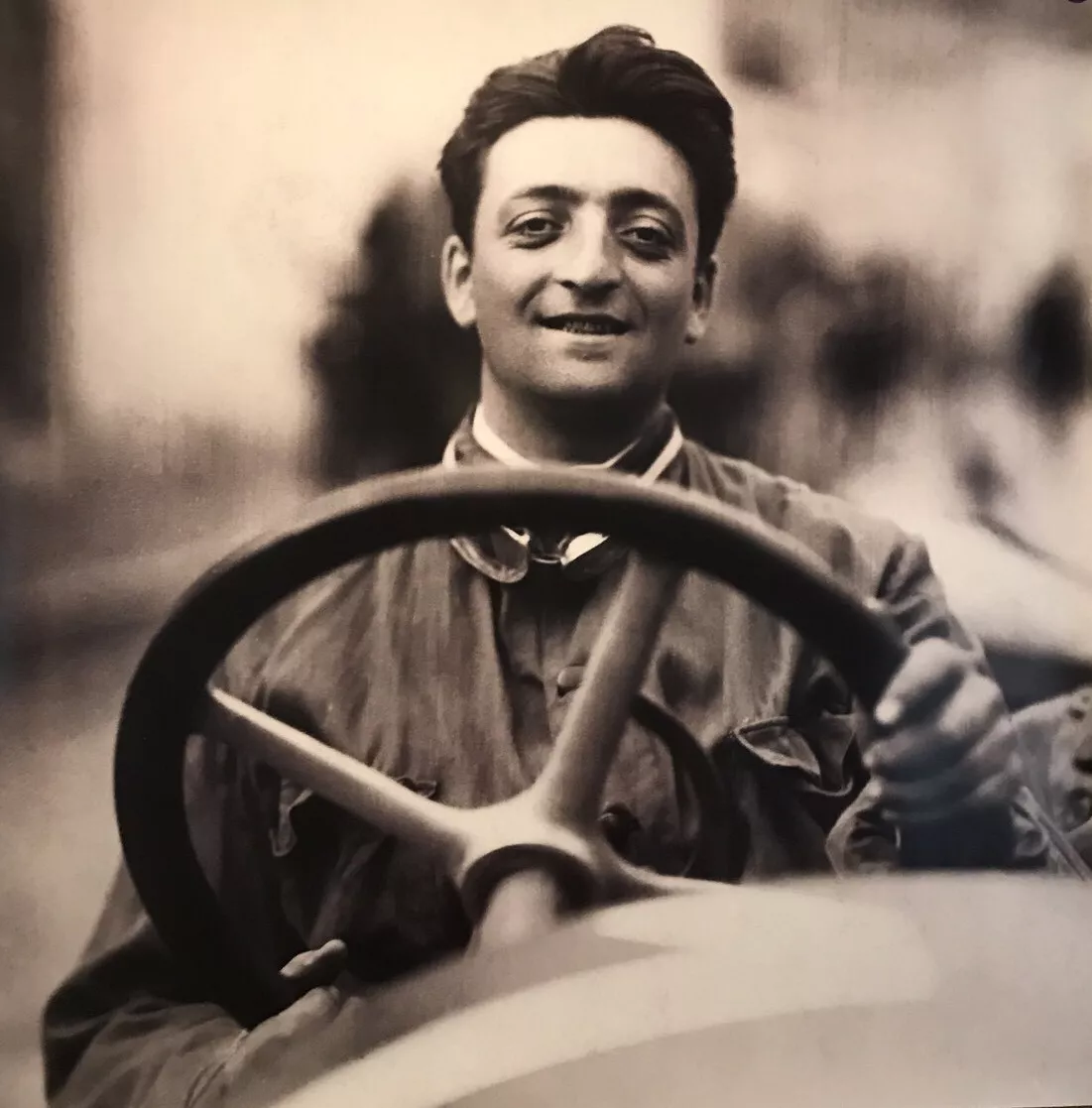
Enzo Ferrari

1930s
The Alfa Romeo P3 was used by the Scuderia Ferrari racing team, which was founded by Enzo Ferrari in 1929 as a racing division for Alfa Romeo. The P3 featured a yellow shield with a black horse on its nose, which was a continuation of a story that began with Italian fighter pilot Francesco Baracca.
1940s
The Ferrari 166 MM was introduced in 1948 and was designed for long-distance competitions. The car was named after the Mille Miglia, a famous road race that Ferrari cars often won. The 166 MM was light and dynamic, but still structurally stiff, and its engine was modified to run on commercially available fuel.
1950s
In 1957, The Ferrari 250 Testa Rossa, or "Red Head" in Italian, burst onto the racing scene. A response to racing rule changes, it was a powerful evolution of existing Ferrari designs. This stunning machine, with its signature red valve covers, roared to victory in multiple World Sports Car Championships,
1960s
A legend was born in 1962 with the Ferrari 250 GTO. Built to conquer racing, it was the ultimate evolution of Ferrari's 250 GT series. Packing a mighty V12 and sculpted for speed, the 250 GTO left its mark on racing history, becoming both a champion and a collector's dream.
1970s
In 1964, Ferrari unveiled the Ferrari 275 GTB, a successor to their beloved 250 series. This grand tourer offered a thrilling combination: a powerful V12 engine for exhilarating drives and a luxurious interior for comfortable journeys. With its elegant Pininfarina design, the 275 GTB became a symbol of sophistication and speed.
1980s
Ferrari unleashed the Ferrari 288 GTO in 1984. This wasn't the typical Ferrari; it was a homologation special, a street-legal version of a race car. Packing a twin-turbocharged V8 and cloaked in aggressive aerodynamics, the 288 GTO blurred the lines between road and track.
1990s
The Ferrari F40 LM roared to life in 1989. Built for pure racing glory, it was a stripped-down, ultra-powerful version of the iconic F40. With a modified engine pushing even more horsepower and lightweight materials shaving off weight, the F40 LM was a force to be reckoned with on the track.
2000s
In 2002, Ferrari unveiled the Ferrari Enzo, a magnificent homage to their founder. This mid-engine monster brought Formula 1 technology to the streets. Boasting a carbon-fiber body, a powerful V12 engine, and cutting-edge aerodynamics, the Enzo embodied the pinnacle of Ferrari's performance and innovation.
2010s
The Ferrari LaFerrari, meaning "The Ferrari" in Italian, arrived in 2013. This hypercar wasn't just powerful, it was a technological marvel. Ferrari's first hybrid production car, the LaFerrari combined a mighty V12 engine with an electric motor for earth-shattering performance and lower emissions, making it a true innovation in Ferrari's legacy.
2020s
The Ferrari SF90 Stradale, which debuted in 2019, marked a historic shift for the iconic brand. This mid-engine marvel wasn't just powerful, it was Ferrari's first ever plug-in hybrid. Combining a monstrous twin-turbo V8 with three electric motors, the SF90 unleashed a new era of performance, offering both earth-shattering speed and the ability to run on electric power for short distances.

Evolution